
English for Ages 3–5: A Science-Based Roadmap Instead of Panic
An evidence-based guide for parents on introducing English to preschool kids in a natural, pressure-free way. It explores pronunciation, bilingualism, screen time, the silent period, choosing the right teacher, and how parents can effectively support their kid's language learning through scientifically grounded practices.

Guide Content
As an educational technology researcher and an academic specialized in media literacy, I have had the privilege of working with over 125,000 students and more than 850 teachers within the language learning ecosystem I founded in recent years. Throughout this journey, one ultimate truth has become crystal clear: during the preschool years, a kid’s English development isn't shaped by expensive courses or early-start grammar drills; it depends entirely on how much meaningful, enjoyable, and pressure-free language experience they engage in every single day.
I wrote this guide for parents navigating a maze of endless questions. Concerns like “Am I too late?”, “Will it confuse their native language?”, “I don’t speak English well, how can I support them?”, or “Is screen time good or bad?” are completely valid. However, the answers to these questions shouldn't come from marketing buzzwords, but from decades of research in language acquisition and developmental psychology. Each topic you will find below is grounded both in this scientific foundation and our hands-on experience in the field.
Between the ages of 3 and 5, your goal shouldn't be to teach your kid English, but to naturally introduce them to it. At this stage, language is acquired "effortlessly"—just like their native tongue—through play, songs, stories, and daily routines.
01Why is the Preschool Period So Special for Kids?
The human brain is never as receptive to new sound systems as it is between the ages of 3 and 5. At this age, kids can distinguish and internalize sounds that don't even exist in their native language—a superpower that gradually fades in the following years. Studies on babies by neuroscientist Patricia Kuhl have shown just how powerful this "auditory flexibility" really is: very young kids can pick up the sounds of a new language with astonishing speed and accuracy.
But there is a very critical detail here, one that forms the foundation of any language strategy for this age group. The most striking finding of Kuhl's research is that young kids learn these sounds through live human interaction, not from a screen. When comparing babies exposed to the exact same language content via a screen versus a real person, there was a dramatic difference in how much they actually learned. We will revisit this finding later in the guide—especially when we discuss screen time—because it is perhaps the single most misunderstood aspect of preschool language education.
So, what should we actually expect from kids during this special period? Many parents expect their kids to start forming full sentences within a few months, and they panic when it doesn't happen. In reality, a healthy and realistic picture of expectations looks like this:
| Stage | What Your Kid Does | The Parent's Role |
|---|---|---|
| 1. Listening & Familiarization | Listens to sounds, rhythm, and repetitive patterns; does not react or respond yet. | Providing plenty of clear, engaging exposure; being patient. |
| 2. Understanding | Responds to simple commands (“clap your hands”) and points to objects. | Supporting with movement (TPR - Total Physical Response), using playful gestures and facial expressions. |
| 3. Single Words | Starts saying individual words like “apple”, “dog”, or “red”. | Validating, repeating after them, and never directly correcting mistakes. |
| 4. Short Phrases & Chunks | Uses memorized phrases and routine chunks like “Thank you” or “I want…”. | Integrating these daily phrases into regular family routines. |
| 5. Creative Production | Begins to build original sentences (typically closer to school age). | Praising their effort to communicate and overlooking grammar errors. |
Think of this table like the changing of the seasons, rather than a race. Some kids might stay in Stage 2 for months, and then suddenly "jump" straight to Stage 4. That is completely fine; in fact, it is a healthy and expected part of their development.
Play: The True Language of Learning at This Age
For 3 to 5-year-old kids, play isn't a "break" from learning—it is the learning. Lev Vygotsky, one of the most prominent figures in child development, showed that kids learn best in what he called the "zone of proximal development." In simple terms, this is the sweet spot where a kid can't quite do something on their own yet, but can succeed with a little help (or "scaffolding") from an adult or a more knowledgeable peer.
When it comes to learning English, the practical takeaway is this: you shouldn't just leave your kid alone and say, "learn this." Instead, you need to experience the language together through a game, a song, or a story, giving them just enough support so they can grasp it.
Because of this, the most effective approach in the preschool years involves games that engage multiple senses, get the body moving, and pull meaning from context. A kid won't memorize the word "apple" by staring at a flashcard; they learn it while holding a real apple, hearing it in a catchy song, spotting it in a picture book, and playing a lively game of "Give me the apple, please!" Language sticks when it stops being an abstract subject and becomes a hands-on, concrete experience. If you keep this core principle in mind, you will understand exactly why almost every piece of advice in this guide revolves around games, songs, and stories.
02What's the “Perfect Age” for Kids? The Truth About the Critical Period
This is the number one question I get from parents, and it usually carries a hidden anxiety: "Am I already too late?" Let me be clear: scientifically speaking, there is no single "perfect age" to start learning a second language. However, the 3 to 5 age range is a unique window of opportunity, especially when it comes to naturally picking up pronunciation and a native-like accent.
I want to clear up two very common misconceptions here:
- The "critical period wall" is a myth: There is no strict "it's impossible after this age" cutoff in language learning. Instead, there is a "sensitive period" where the brain's flexibility gradually decreases. So, while ages 3 to 5 give them a great head start, beginning at 7, 10, or even 14 does not mean the ship has sailed. Millions of people have successfully mastered a second language later in life, and it’s no different for your kids. That’s why I highly recommend dropping the "Is it too late?" panic and channeling your energy into how you can start right now.
- Starting early does not mean "more lessons: " The real advantage at this age is that kids simply absorb the language through play, completely free from analytical pressure. If you try to turn this into a traditional, sit-down grammar lesson at a desk, you are completely wasting that incredible advantage.
The Science Behind It
In language learning, there is a well-known concept called "less is more." Because young kids process information in a simpler way, they don't overanalyze the language. Instead, they naturally pick it up in complete chunks and patterns. While adults might learn grammar rules faster, young kids develop a much more natural accent and an intuitive feel for the language. This is exactly why the preschool years are the perfect time for "exposure" rather than formal "teaching."
03Is It Possible to Raise a Bilingual Kid in a Non-English Speaking Country?
Yes, it is absolutely possible—but we need to set realistic expectations. In a non-English speaking country where the language isn't casually spoken on the streets, you can't raise your kid under the exact same conditions as a kid growing up in London. Expecting that will only lead to frustration.
However, achieving "functional bilingualism" is a completely realistic goal. Your kid can grow up understanding English, expressing themselves confidently, and being totally fearless when using the new language.
The secret to this lies in one single concept: exposure. A kid picking up their native language naturally hears it thousands of times a day. While you might not be able to create that exact level of 24/7 immersion for English, you can build a consistent, daily "English island" right in your own home.
Here are the strategies that make this possible:
| Method | How to Apply | Daily Goal |
|---|---|---|
| Fixed Time Slots | Setting a specific "English time" at the same hour every day (e.g., during breakfast or bath time). | 15–30 mins |
| Songs & Rhythm | Using nursery rhymes and action-packed, high-energy songs. | 2–3 songs |
| Interactive Reading | Reading English picture books out loud while asking interactive, dialogic questions. | 1 book |
| Quality Content | Watching slow-paced, repetitive, and educational cartoons or shows together. | 15–20 mins |
| Micro-Routines | Weaving everyday commands into English (e.g., “Let’s wash hands”). | Spontaneous & Ongoing |
Notice how none of the items in this table require you, as a parent, to speak fluent English. This is a crucial point, and I will dedicate an entire section to it a bit later.
How to Build a Bilingual Routine at Home?
Globally, there are two tried-and-true strategies for raising bilingual kids, and both can easily be adapted to families living in non-English speaking countries:
- One Parent, One Language (OPOL): One parent (or a caregiver, or teacher) consistently speaks only one language with the kids. If someone in the household speaks English fluently, having them consistently speak English helps the kids' brains quickly map the connection: "this person = this language."
- Time and Place: If no one in the household is a fluent English speaker, this approach is much more realistic. A specific time slot or a designated physical area becomes the "English zone." For example, this could be the 20 minutes right after dinner every evening, or a cozy "English corner" in the playroom. The key here is consistency: when kids can predict exactly when and where they will encounter English, their minds are naturally primed and ready for it.
No matter which method you choose, the golden rule remains exactly the same: consistency and predictability. A kid's brain thrives on routines. Short, regular doses of daily exposure are far more effective than massive, irregular cram sessions.
04Will It Confuse or Weaken Their Native Language? — A Clear Answer to the Biggest Fear
This is often the deepest concern for parents, and unfortunately, it is the one where they are most frequently misinformed. Let me be completely clear: exposing your kids to two languages does not damage, delay, or weaken their native tongue. This is a thoroughly proven, well-established finding in the field of linguistics.
The exact behavior that usually triggers this parental worry is when kids mix both languages in a single sentence: "Mom, can you give me that red car?" (using a word from the new language mid-sentence). In linguistics, this is called code-mixing, and it is actually a sign of intelligence and resource management—not confusion. Your kid is simply using the first word that pops into their head to keep the conversation going.
This behavior naturally fades away around the ages of 4 or 5 as kids learn which language belongs to which context.
| Common Fear (Myth) | Scientific Fact |
|---|---|
| “Learning two languages will confuse my kid.” | A kid's brain is naturally wired to process two (or even three) languages simultaneously. Instead of confusion, it fosters cognitive flexibility. |
| “Their native language will lag behind.” | As long as the native language is actively supported at home, there is no regression. Bilingual kids might sometimes know fewer words in each individual language initially, but their total vocabulary across both languages is equal to or greater than that of their peers. |
| “Mixing words from both languages is a sign of a problem.” | Code-mixing is a completely normal and temporary milestone in development; it is not a speech or language disorder. |
| “They should master their native language first before starting English.” | This is not necessary. While a strong native language provides a solid foundation for English, waiting too long can narrow the optimal window of opportunity for effortless acquisition. |
Key Concept: Additive Bilingualism
According to the framework developed by linguist Jim Cummins, two languages do not sit in the brain like two isolated islands; rather, they share a common underlying proficiency. This means the concepts your kid learns in their native language—such as sequencing, cause-and-effect, and storytelling—naturally transfer over to English. Strengthening the native language does not undermine the second language; it creates a solid foundation for it. Therefore, the most robust strategy is not to abandon the native language, but to continue enriching it while adding English into the mix.
In short: keep speaking plenty of rich, high-quality native language at home. A strong native tongue is not the enemy of good English; it is its most powerful ally.
05Can a Kid Start Learning English Before They Can Read or Write?
My shortest answer to this question is simple: not only can they learn, but this is actually the most natural time to start. Think about it for a second: your kids picked up their native language years before they ever learned how to read or write. No baby starts learning a language with the alphabet. Language enters through the ears and the mouth first; letters come much later.
During the preschool years, English learning should be entirely oral-based. One of the biggest mistakes you can make at this age is forcing kids into early spelling or writing exercises. Instead, our focus should be on:
- Phonological awareness: Playing with rhyming nursery rhymes, rhythm, and words that start with the same sounds.
- Listening & imitation: Humming along to song choruses and mimicking fun sounds.
- Sound-meaning association: Pointing to a cat in a picture book while saying the word "cat."
- Physical response: Responding to commands like "Jump!" or "Touch your nose!" with active movement (a method known as Total Physical Response or TPR).
When you build this rock-solid oral foundation, it becomes much easier for kids to develop literacy in both their native language and English later on. Not knowing how to read or write isn't a barrier at all—it is the ultimate starting point.
06“My Kid Understands but Doesn't Speak” — Understanding the Silent Period
So many parents come to me filled with worry: "They understand everything I say, they follow along with the cartoons, but they won't say a single word in English. Is something wrong?" In almost every case, the answer is a definitive no. There is nothing wrong. Your kid is simply going through the "silent period."
The silent period is an incredibly common and completely healthy stage for kids acquiring a second language. Just like a baby spends months just listening before uttering their very first word, a kid learning a new language needs to absorb it first. They are quietly collecting sounds, rhythms, and patterns in their mind. Then, when they feel fully ready, they will start speaking. This phase can last for weeks or even months, and its duration varies wildly from one kid to another.
The Silent Period: Do’s and Don’ts
Do: Keep providing clear, comprehensible input, create pressure-free opportunities to speak (e.g., “Do you want the apple or the banana?”), and validate your kid's responses through body language.
Don't: Pressure them with demands like “Come on, say it!” or “Why aren’t you speaking?”, expect public performances in front of others, or constantly correct their mistakes.
This is where the concept of the affective filter comes into play. According to this idea developed by linguist Stephen Krashen, when anxiety, embarrassment, and pressure increase, the brain's capacity to process language input plummets. It's as if an invisible filter blocks learning.
Forcing kids to speak raises this filter, creating the exact opposite of the desired effect. On the flip side, a relaxed, safe, and fun environment lowers the filter and naturally clears the path for them to start speaking.
07Local Teacher vs. Native Speaker?
"Does it absolutely have to be a native speaker?" This is easily the most exaggerated and commercially exploited myth in language education. Let me be completely blunt: a well-trained local teacher who understands child pedagogy and has a warm demeanor is far more effective than an average native-speaking teacher who fails to build a real connection with your kids.
An educator's true value isn't determined by the country on their passport, but rather by the following qualities:
| What Truly Matters | What Is Secondary |
|---|---|
| Building a warm, secure connection with the kid | Whether the teacher is a native English speaker or not |
| Providing clear, simple, and comprehensible input | Having a "perfect" American or British accent |
| Using play-based, multisensory teaching methods | Advanced expertise in complex grammar theory |
| Patience, a sense of humor, and zero-pressure techniques | Expensive materials and textbook bundles |
| Using the kid's native language as a bridge when necessary | A strict, English-only immersion approach at all costs |
In fact, a local teacher offers a distinct advantage: because they know the kids' native language, they can act as a bridge during a breakdown in communication, pinpoint exactly why they are struggling, and make them feel completely safe. As long as they provide a clear and understandable model for pronunciation, having a "native" teacher is not a requirement—at most, it is a secondary preference.
08My Kid is Shy Around Foreign Teachers
This reaction is completely natural, especially for kids who are naturally shy or tend to take a cautious approach to new environments. The affective filter I mentioned earlier is at play here too: when a kid doesn't feel entirely safe, their brain's learning door shuts tight. The solution is never pressure; it is gradual trust-building.
Here is how you can help them ease into it:
- Connection first, lessons second: Treat the initial sessions purely as "meet-and-greet playtime," not formal learning. The goal isn't to teach a single new word; it's simply to get a smile from your kid.
- Short but frequent: At this age, a single 45-minute lesson can feel overwhelming. Short, 15-minute bursts are far more effective and do wonders for reducing shyness.
- Be their "safe harbor": Stay close by during the first few sessions, but don't interfere. Let your kid glance back at you occasionally just to recharge their sense of security.
- Use familiar objects as a bridge: Bring your kid's favorite toy or storybook into the session. Having a comforting, familiar object nearby makes a new face feel a lot less intimidating.
- Drop the performance expectations: Remember that just watching and listening is active learning. Speaking will happen naturally once your kid feels ready.
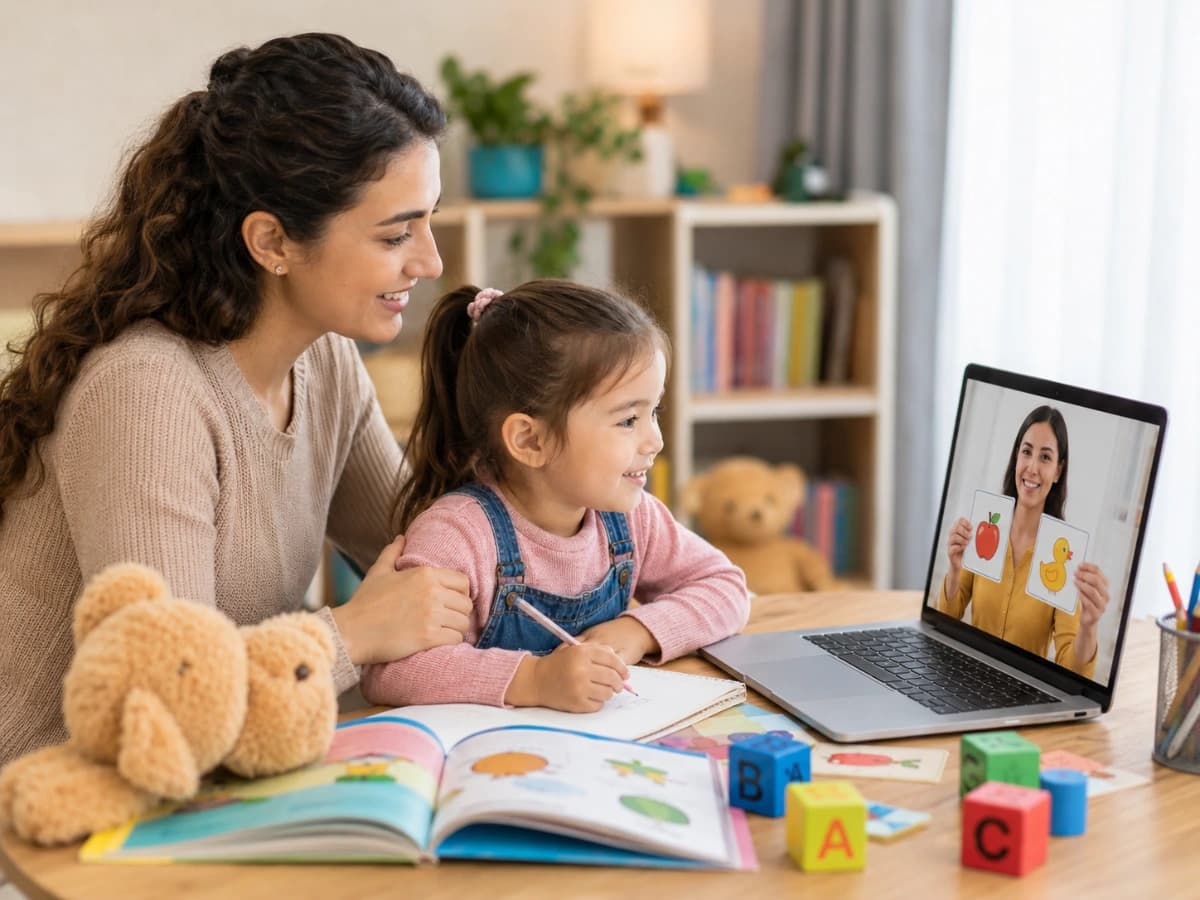
Within just a few sessions, you will likely see most of that shyness melt away, and they might even start looking forward to their next c
09“My Partner and I Don't Speak English” — How You Can Still Support Your Kids
This is perhaps the section where I need to reassure you the most. Many parents feel like they are holding their kids back simply because their own English isn't perfect. This is absolutely not true. Your kids' greatest supporter isn't a parent who speaks fluent English; it's a parent who brings a positive, curious, and consistent attitude toward learning.
Your role isn't to teach. Your role is to clear the path, set up the environment, and celebrate your kids' efforts. Here is exactly what you can do without knowing a single word of English:
- Experience the content together: Listen to an English song or watch a cartoon together. Even if you don't understand the words, laughing along sends a powerful message: "this is fun, and this is valuable."
- Show curiosity instead of translating: Step into the role of the learner. Say things like, "I wonder what that word means, should we find out together?" Kids absolutely love teaching things to their parents.
- Manage the routine: You don't need to speak English to kick off "English time" at the exact same hour every day; you just need to hit the play button.
- Model a positive attitude: Avoid saying things like, "English is just so hard." Kids copy their parents' attitudes toward language word for word.
- Make technology your ally: Today, AI-powered educational platforms can easily step in to model perfect pronunciation, provide instant feedback, and adapt beautifully to a kid's individual pace. This is exactly what I have been researching and developing for years: using technology not to replace the parent, but to support them.
Remember
The greatest language gift you can give your kids isn't a flawless accent; it is the deep belief that learning is something enjoyable, safe, and incredibly valuable. You don't need to know English to give them that belief.
What Does This Look Like in Practice? An Example
Let’s say you don’t speak any English at all, and you are looking at an animal book with your kid. There is a picture of a cat on the page, and underneath, it says "cat." Here is exactly what you can do: point to the cat with your finger, listen to the audio together (if it's a sound book or by checking the pronunciation on your phone), and then both of you can say "caaat" out loud. You smile and connect it to real life by saying, "Our cat Fluffy is a cat too, right?" In that single, brief moment, you have given your kid four things all at once: a new word, a correct pronunciation model, a meaningful context, and—most importantly—the feeling that learning is a joyful experience shared with you. That is a parent's true power. It isn't about teaching perfect grammar rules; it's about these shared moments.
10How to Balance Screen Time? A Matter of Media Literacy
As someone working in the field of media literacy, I care deeply about this particular topic. That is because when it comes to early childhood English, screens are both our greatest opportunity and our most common trap.
Let’s recall the finding by Dr. Patricia Kuhl that I mentioned at the beginning of this guide: very young kids do not pick up language from passively watching screens; they learn through live, social interaction. This doesn't mean we need to ban screens entirely, but it does mean we need to radically change how we use them. The ultimate secret lies in one concept: co-viewing.
Passive viewing—where a kid sits completely alone and silent in front of a device—is almost entirely ineffective for language acquisition. On the flip side, watching that exact same content alongside an adult, pausing to chat, pointing at things, and asking simple questions transforms the screen into a rich social interaction. This simple shift multiplies their learning potential exponentially.
| Passive Screen Time (Ineffective) | Interactive Screen Time (Effective) |
|---|---|
| The kid is left alone with the screen running in the background | Watching together with a parent, complete with eye contact and conversation |
| Long, uninterrupted viewing sessions | Short clips with frequent pauses to chat about what's happening |
| Fast-paced videos with overwhelming or unclear context | Slow-paced, highly repetitive, and simple storytelling |
| The language experience starts and ends on the screen | Bringing the content into the real world (e.g., “Look, an apple, just like in the song!”) |
Practical Screen Time Rules (Ages 3–5)
- Keep it short and high-quality: Think in terms of purposeful minutes, not endless hours.
- Co-view whenever possible: Watch the content together with your kid.
- Choose the right pace: Opt for slow-paced, repetitive, and song-based content.
- Bridge to the real world: Carry what they watch into your daily family life and routines.
- Protect bedtime: Avoid any screen exposure right before sleep.
- Reframe the device: Avoid positioning the screen as a "reward" or a "babysitter"; instead, treat it as a planned, intentional learning tool.
11Which Stories, Media Content, and Books Should I Choose for My Kids?
Content selection is the absolute heart of preschool English acquisition, and it falls directly under the umbrella of media literacy. Not every piece of English content is suitable for language development. Fast-paced, noisy videos with rapid scene changes easily overwhelm a young kid's language processing capacity.
Instead, the features you should actively look for are:
| Criterion | Why It Matters | Practical Tip |
|---|---|---|
| Slow Pace | Gives your kid's brain enough time to process new sounds and words. | Look for gentle transitions and slow scene cuts. |
| Repetition | Repetition is the ultimate engine of language acquisition. | Don't get bored of playing the same song or reading the same book over and over! |
| Visual-Context Match | Kids learn by mapping what they see to what they hear. | Whatever is being said should be clearly visible on the screen. |
| Simple & Concrete | Abstract concepts are too complex for this developmental stage. | Focus on everyday objects, animals, colors, and numbers. |
| Music & Rhythm | Melodies make language patterns much easier to memorize. | Opt for music-heavy programs and sing-alongs. |
| Age Appropriateness | Scary or aggressive elements trigger stress, which shuts down learning. | Always preview the content yourself first. |
Recommendations by Content Type
| Format | How to Use |
|---|---|
| Nursery Rhymes | The ultimate tool for this age group. Rhythm and repetition naturally reinforce language patterns. Pair them up with physical movements and gestures. |
| Picture Storybooks | Engage in dialogic reading: pause, ask questions, have your kid point at drawings, and encourage them to guess what happens next. |
| Short Music Videos | Watch them together first, then sing the song along without the screen during playtime. |
| Audio Stories | Great for listening practice without the screen fatigue; ideal for family car rides and road trips. |
| Simple Digital Apps | Opt for age-appropriate, ad-free applications that offer interactive features and gentle feedback. |
What Is Dialogic Reading?
Dialogic reading means turning a storybook into a live conversation rather than just reading it from cover to cover. By asking simple questions like “What is this? Yes, a dog! What does the dog say?”, you shift your kid from a passive listener to an active participant. Research shows that this interactive method boosts a kid's vocabulary much faster than traditional passive reading. Best of all, even if your own English is limited, you can easily practice this by chanting the simple, repetitive phrases in the book together.
What to Avoid?
When choosing content, knowing "what to avoid" is just as crucial as knowing "what to play." The following types of content will exhaust and distract your kids rather than support their language processing:
- Overly fast editing: Videos that flash through multiple scene changes per second might look dazzling, but their meaning gets lost. Kids end up hyper-focusing on the visuals instead of listening to the language.
- Age-inappropriate topics: Content with suspense, scary elements, or overly complex plotlines. Anxiety utterly derails the learning process.
- Mismatched visuals and meaning: Materials where what is being said doesn't line up with what is happening on screen. This makes it impossible for kids to crack the code of the language's meaning.
- Leaving the screen on as "background noise": Having an English show running in the background when no one is actually watching does not teach language; it simply turns into white noise.
- The ad and auto-play trap: Platforms that automatically drag your kids into the next random video. Make sure you select the content instead of letting an automated algorithm run the show.
Before you open any piece of content for your kid, ask yourself one simple question: "Is this content helping my kid understand, or is it just distracting them?" Developing this simple media literacy habit will save you from making a ton of common mistakes.
12The 7 Most Common Mistakes Parents Make
Over the years, I have observed the journeys of thousands of families. The mistakes that well-intentioned parents fall into time and time again are surprisingly similar. Here are the most common ones along with their antidotes:
| Mistake | Why It's Harmful | What to Do Instead |
|---|---|---|
| 1. Forcing them to speak | Raises the affective filter, triggering anxiety and fear. | Patiently providing clear, comprehensible input. |
| 2. Constantly correcting errors | Discourages the kid from wanting to communicate. | Praising their communicative effort and repeating the correct version by modeling it naturally. |
| 3. Imposing early grammar or writing | Not developmentally appropriate; completely kills the fun of learning. | Sticking to a purely spoken, play-based approach. |
| 4. Lack of consistency | A single intense weekly session is far less effective than 15 minutes of daily exposure. | Keeping up with short, fixed daily routines. |
| 5. Relying on passive screen time | Leaving a kid to watch video content alone does not teach them a language. | Co-viewing the content and chatting about it afterward. |
| 6. Comparing milestones with other kids | Every kid develops at their own unique pace; comparison only creates pressure. | Focusing purely on your own kid's individual progress. |
| 7. Stepping back with an "I don't speak English" excuse | Shuts down the most powerful support system: your positive attitude and daily routine. | Becoming a fellow learner and sharing the curiosity with them. |
13The Long-Term Benefits of Starting Early for Kids
The return on investment for preschool English goes far beyond just language skills. Research shows that early, healthy bilingualism provides significant advantages at the cognitive level as well.
The ground-breaking work of cognitive scientist Dr. Ellen Bialystok indicates that bilingual kids can develop distinct strengths, particularly in the area of executive functions—including attention management, switching between tasks, and impulse control.
| Area | Potential Benefit |
|---|---|
| Pronunciation & Accent | A more natural, less "foreign" accent; enhanced ability to distinguish and mimic native sounds. |
| Cognitive Flexibility | The habit of switching between two language systems continuously nurtures mental agility. |
| Metalinguistic Awareness | An early, intuitive understanding of "how language works" underneath the surface. |
| Confidence & Lack of Fear | Kids exposed to English early and without pressure grow up with zero language anxiety. |
| Academic Foundation | Strong listening comprehension skills accelerate reading and writing readiness during school age. |
| Cross-Cultural Openness | Early familiarity with diversity fosters deep empathy and a global citizen mindset. |
I must make a crucial warning here: these cognitive advantages are the result of "early, healthy, and joyful exposure," not "forcing early academic lessons." An oppressive, high-pressure approach that stresses out your kids will completely fail to provide these benefits. Worse, it can cause them to permanently shut down and pull away from the language entirely. That is why your method is just as important as the age at which you start.
14A Sample Weekly Routine for Kids
To turn theory into practice, here is a sample weekly breakdown you can easily implement at home, requiring just 20 to 30 minutes a day. It does not demand fluent English from you and is completely flexible—feel free to adapt it based on your kids' unique interests.
| Day | Activity | Duration |
|---|---|---|
| Monday | 2 nursery rhymes + active "TPR" games (jump, touch, clap) | 15 mins |
| Tuesday | Picture book time — engage in dialogic reading | 15 mins |
| Wednesday | Co-viewing a short video + a light chat about it afterward | 20 mins |
| Thursday | Singing along + weaving daily commands into English | 15 mins |
| Friday | Color, number, or animal games (using concrete real-world objects) | 15 mins |
| Saturday | Interactive live session with a teacher or an educational app | 20–25 mins |
| Sunday | Free choice: replay your kid's absolute favorite piece of content (repetition is key!) | Flexible |
The Golden Rule
Consistency beats intensity. Spending 15 minutes of enjoyable, bite-sized language exposure every day yields far more powerful results than a grueling one-hour lesson once a week. Keep it small but regular; pressure-free but ongoing.
15My Final Words as an Expert for Your Kids
After years of working in educational technology and language acquisition, I can summarize the single fact that anxious parents miss most frequently: the real measure of success in early childhood language learning is not how much English your kids know, but how positive their relationship with English actually is. The most precious gift you can give your kids at this age is not a few dozen vocabulary words; it is a fearless, curious, and joyful attitude toward the language. Words will come on their own later down the road, but once that positive attitude is damaged, repairing it can take years.
That is why I ask only one thing of you: please do not view this process as a race. Do not compare your kids to the neighbor’s child, a classmate, or those "fluent in English at age 3" examples on social media. Every single kid has their own unique rhythm, their own silent period, and their own breakthrough moment. Your job is not to force this rhythm, but to prepare a safe, rich environment for it. Be consistent, be patient, and most importantly, enjoy the process itself. Because in the future, your kids will remember the sense of security they felt by your side far more than the specific vocabulary words they learned.
Having personally observed what can be achieved when technology and proper pedagogy come together, I can confidently tell you this: for kids who are supported with the right tools, a patient approach, and unconditional love, there is no such thing as "impossible" on this journey. As long as the beginning is rooted in play, not pressure.
16Frequently Asked Questions
What is the best age to introduce my kid to English?
The best time to start is today. The ages of 3 to 5 are a golden window because the brain is incredibly flexible, particularly for mastering pronunciation and developing sound sensitivity. However, there is no rigid "critical age barrier." At this stage, the goal isn't structured lessons; it's about weaving enjoyable, comprehensible language exposure into play, songs, stories, and daily family routines.
Will raising my kid bilingually confuse or weaken their native language?
Not at all. Switching between two languages (code-mixing) is a sign of healthy cognitive development, not confusion, and it typically decreases naturally around ages 4 to 5. When the native language is actively supported at home, a second language won't weaken it; on the contrary, a strong native language provides the bedrock for English. This process is known as "additive bilingualism."
Can kids who don't know how to read or write yet start learning English?
Yes, in fact, this is the most natural way to begin! In early childhood, language is acquired first through listening and speaking, just like they picked up their native tongue. Reading and writing are not prerequisites. When a solid verbal foundation is laid early on, literacy skills develop much more effortlessly later in school.
My kid understands English but refuses to speak it. Is this normal?
This is completely normal in most cases. It is known as the "silent period," a phase where kids internalize the language by listening extensively before producing it. During this stage, rather than forcing your kid to speak, it is essential to keep providing clear, comprehensible input and offer pressure-free opportunities to communicate.
Can my kid's teacher share their native language, or do they have to be a native English speaker?
A skilled, non-native teacher can be far more effective than a mediocre native speaker. The deciding factor is never the teacher's passport, but their ability to connect warmly with your kid, deliver comprehensible input, and master early childhood pedagogy. Having a clear, easy-to-understand accent is more than enough.
Neither my spouse nor I speak English well. How can we support our kid?
Fluency in English is not required on your part. Establishing a consistent routine, listening to songs together, co-viewing high-quality content, validating your kid's interests, and modeling a positive attitude toward the language are the most powerful ways to help. Your role isn't to teach, but to cultivate a welcoming space for learning.
How should parents balance screen time when it comes to language learning?
Young kids learn language from meaningful social interactions, not from passive screen consumption. Therefore, digital content should complement real-world interactions, not replace them. When used, screen time should be high-quality, brief, co-viewed with a parent, and actively carried over into daily chats. Quality and companionship matter far more than total screen minutes.
My kid is shy or anxious around foreign teachers. How can we overcome this?
Shyness usually means that the kid's affective filter is raised, blocking easy learning. The solution is never pressure; it's about building trust. Short and frequent introductory meetups, play-based initial sessions, having a parent close by, and a warm, non-judgmental attitude from the teacher will quickly melt that shyness away.
This content is provided for general informational and parental guidance purposes only, rooted in established research frameworks within language acquisition and child development. If you have any specific concerns regarding your kid's language or speech development, we highly recommend consulting a professional, such as a child development specialist or a speech-language pathologist.
© 2026 · All rights reserved. Author: Assoc. Prof. Dr. Sait Tüzel.