


Flalingo Kids

Parent Academy:
A Guide to English Education for Children

Our content is prepared by academics specialized in language acquisition, child development, and education from leading universities in Turkey.

Expert Staff

Language development in children should be supported with continuity and proper exposure.

Dr. Sezen Korkmaz

Dr. Sezen Korkmaz · School of Foreign Languages, Department of Basic English, Middle East Technical University

Content Center

All our content is fed from a single center. Learn in the format you want.

Age-Based Guides

Each age group has its own unique needs. Quickly access content suitable for your child's age.

Do you want to learn your child's level?

Start with the Level Test
Most Watched

Highlighted Expert Opinions

Answers from our academics to the questions that parents are most interested in

See All Questions
Teaching English to Kids Aged 3-5: Why Should We Start Early?
Age & Timing
Psk.Dan. Gülsüm Özışık
Read
Is My Kid Too Late to Learn English? | The Truth About the "Critical Age"
Age & Timing
Dr. Sezen Korkmaz
Read
Are Online English Classes Harmful for Kids Raised Screen-Free?
Screen Time
Psk.Dan. Gülsüm Özışık
Read
Success Stories

Inspirational Stories from Our Families Inspiring

We offer you the best solution based on the experiences of thousands of families.

Live Video
Video Story

We Reached B1 Level in 6 Months

My daughter can now watch English cartoons and form simple sentences.

Ayşe Yılmaz

Ayşe Yılmaz

2 Children Mother • Child: 7 years old

6 months
Google

"My son used to hate English class. Now he asks every day, 'Is there class today?' Seeing this transformation is incredible."

Mehmet Kaya

Mehmet Kaya

Coder Dad

98%

Parent Satisfaction

edtechbreakthrough
Zeynep & Ela

"We learn together, we grow together."

Zeynep & Ela

Mother-Daughter

Trustpilot
Selin Demir

"As a professional educator, I can say that this methodology really works. It respects children's natural learning processes."

Selin Demir

Teacher Mom • Child: 6 years old

Getting Started Guide

Beginner's Guide to My Child's English Education

The right start in your child's English education begins with accurately analyzing their level, progressing with age-appropriate content, and establishing a sustainable routine.

1

Determine the Correct Level

Every child's starting point is different. Accurate level analysis is the foundation for creating a learning plan that meets the child's needs.

Set the Level
2

Choose Age-Appropriate Content

Learning in children becomes more effective with content suitable for age, attention span, and areas of interest. The right materials increase motivation.

Discover the Contents
3

Establish a Regular Learning Routine

Language development is strengthened through regular repetition. Short, planned, and sustainable activities enable the child to adopt English naturally.

Create a Plan

All Questions & Answers

How Can I Support My Kid's English Learning at Home?
Parental Support
Dr. Sezen Korkmaz

Dr. Sezen Korkmaz

Middle East Technical University

How Can I Support My Kid's English Learning at Home?

Your kid might be learning English at school, but is it really enough? Discover how you can support their English progress with short daily routines, active language practice, and interactive online platforms right at home.
Teaching English to Kids Aged 3-5: Why Should We Start Early?
Age & Timing
Psk.Dan. Gülsüm Özışık

Psk.Dan. Gülsüm Özışık

Teaching English to Kids Aged 3-5: Why Should We Start Early?

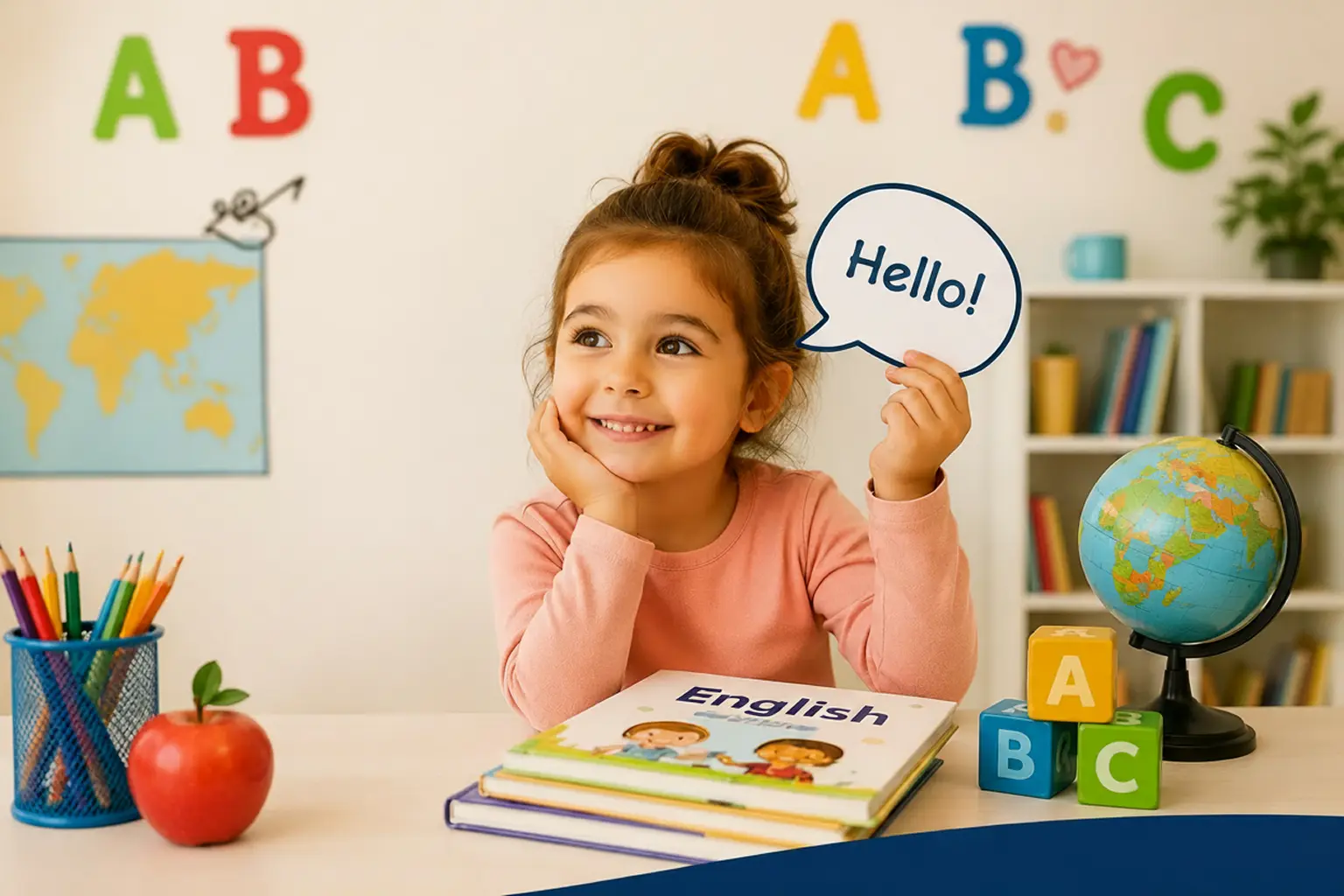
Why is learning English at an early age important? Discover brain development in 3-5 year olds and the ability to "think in English" with insights from Psychological Counselor Gülsüm.

Is My Kid Too Late to Learn English? | The Truth About the "Critical Age"
Age & Timing
Dr. Sezen Korkmaz

Dr. Sezen Korkmaz

Middle East Technical University

Is My Kid Too Late to Learn English? | The Truth About the "Critical Age"

Has your kid started learning English too late? Discover the academic perspective on the concept of the "critical period," the importance of motivation, and the right learning strategies for successful language acquisition.

Are Online English Classes Harmful for Kids Raised Screen-Free?
Screen Time
Psk.Dan. Gülsüm Özışık

Psk.Dan. Gülsüm Özışık

Are Online English Classes Harmful for Kids Raised Screen-Free?

Does enrolling your kid in online English lessons cause screen addiction? Discover the difference between "passive" and "active" screen time, and explore the benefits of interactive learning for young English learners.

Raising a Bilingual Kid: Is It Really Possible?
Bilingual Development
Dr. Sezen Korkmaz

Dr. Sezen Korkmaz

Middle East Technical University

Raising a Bilingual Kid: Is It Really Possible?

Is raising a bilingual kid in a non-native English-speaking country just a dream? Discover how to manage your expectations and create a sustainable language environment.

2500+ Certified Teacher

Discover the Right English Journey for your child

With Flalingo Kids, your child will learn English in a fun and effective way with expert teachers. Try the first lesson for free!

30 Day Guarantee
4.9/5 Rating
200,000+ Students
Frequently Asked Questions

Frequently Asked Questions

There is no single "perfect age" to start English education in children; however, it is quite valuable to introduce the language through play, songs, stories, and daily routines at an early age. From the age of 3, a child can hear English not as a subject but as a natural language of communication and play. The age range of 4-6 is quite suitable for structured preschool English programs.

A child can start a course from the age of 4; however, the aim of the course at this age is not to teach grammar, but to develop a positive attitude towards English. The most suitable course for the 4-6 age group is a short-term, play-based program that includes plenty of visuals and movement, and does not force the child to speak. After the age of 6, children become more ready for a more structured lesson format, simple question-and-answer sessions, and age-appropriate assessment and evaluation activities.

In the English course for 4-6 year olds, children should not be kept sitting at a desk for long periods. Lessons should progress with songs, drama, puppetry, drawing, matching, coloring, active games, and daily expressions. The goal for this age group is not "how many words the child has memorized," but rather their attempt to understand when they hear English, their response to commands, and their beginning to use simple patterns naturally.

Preschool English education should be a program that is suitable for the developmental characteristics of the child, progressing with short repetitions and centered around play. In Oxford's preschool English program, communicative goals, target vocabulary, materials, projects, methods, and techniques are structured according to age groups. At the core of the program is the idea that children learn English through classroom and daily life experiences.

Children should start learning English with sounds, rhythm, greetings, simple commands, and daily expressions. Phrases like “Hello”, “Good morning”, “What’s your name?”, “I’m fine”, “Sit down”, “Stand up”, “Look”, “Listen” serve as the first points of contact for the child. Following that, words related to their immediate environment should be taught, such as colors, numbers, animals, toys, family members, body parts, foods, and classroom items.

In the first stage, it is essential to teach meaningful and usable expressions rather than the alphabet or grammar rules. In the Oxford University Press 2nd grade English program, basic words such as colors, numbers, classroom items, animals, fruits, body parts, and household items are presented alongside daily language functions like greetings, self-introduction, and describing objects. The program particularly emphasizes visual-audio tools and game-based activities.

First, words that have meaning in the child's life should be selected. The most accurate order is usually as follows: colors, numbers, toys, animals, family members, foods, body parts, clothes, classroom items, household items, emotions, and daily actions. Instead of memorizing words one by one, small meaningful chunks like "red apple," "big dog," "my mother," "I like bananas" should be used in vocabulary teaching.

Grammar should not be taught explicitly in preschool and the early years of primary school. Children should acquire the language intuitively by using patterns such as “I like…”, “This is…”, “Can I…?”, “I have…”. Grammar terms should be explained at a later age when the child is ready in terms of reading-writing and abstract thinking.

The speaking skill develops through the child's ample listening first. When the child hears enough English songs, stories, play language, and simple dialogues, they gradually begin to produce one-word responses, followed by short phrases. In this process, it is more effective for the teacher or parent to model with natural repetitions rather than forcing the child by saying, "Come on, speak English."

Yes, well-chosen games strengthen children's English learning. Memory cards, matching games, "Simon says," color hunts, object finding, role-playing, puppet talks, and active classroom games support both vocabulary repetition and listening-comprehension skills. Games, especially in preschool, transform English from a "subject" into an experience.

English children's songs are very beneficial in terms of pronunciation, rhythm, repetition, and vocabulary memory. However, songs alone are not enough; understanding should be reinforced with movement, pictures, Q&A, or a small game after the song. In Oxford's resources, songs, stories, games, and parent support content are presented together for children.

Cartoons can be supportive; however, they do not teach English on their own. If a child passively watches for a long time, learning remains limited. The best method is to watch a short, age-appropriate video together, and then turn the content into conversation with simple questions like “What color is it?”, “Who is this?”, “Is it big or small?”.

When selecting YouTube content, attention should be paid to whether the video is slow, understandable, repetitive, age-appropriate, and free of ads or under parental control. Instead of videos that are spoken too quickly, contain excessive stimuli, or are solely entertaining, channels that include songs, stories, basic vocabulary, and daily expressions should be preferred. Screen time should be kept short and, if possible, watched with parental accompaniment.

In 1st grade, English support should be provided not through writing, but through listening, repetition, coloring, matching, singing, and games. While the child is learning letters, intensively teaching English spelling rules can be confusing. At this age, the goal is to make children love English, introduce basic vocabulary, and ensure they understand simple classroom commands.

The following questions can be used for beginners: “What’s your name?”, “How old are you?”, “How are you?”, “What color is it?”, “What is this?”, “Do you like apples?”, “Can you jump?”, “Where is the ball?”, “Is it a cat?”, “Who is this?” These questions are short, concrete, and answerable, allowing children to confidently start speaking.

There is no need for long lessons to teach English at home. Small routines of 10-15 minutes each day are sufficient: morning greetings, color work with toys, fruit names during meals, body parts during bath time, a short English story before bed, etc. The parent's English does not have to be perfect; consistent repetition and a positive approach are more important.

Even if parents do not know English, they can support their child's learning process. Choosing reliable song, story, and game resources, dedicating regular time to the child, creating pressure-free opportunities for them to demonstrate what they have learned, and staying in communication with the teacher is sufficient. The most important thing for the child is to create a positive and curiosity-inspiring atmosphere towards English at home.

PDF activities are supportive materials; however, preschool children do not learn a language solely with worksheets. Coloring, cut-and-paste, and matching activities become effective when combined with singing, movement, listening, speaking, and games. Especially for children aged 3-6, English education should include as many sensory experiences as possible.

When choosing an online children's English course, the teacher's experience working with children, lesson duration, class size, play-based methods, speaking opportunities, and parent feedback should be considered. For younger ages, 25-30 minute live and interactive lessons are generally more effective. If the child remains passive on camera, the lesson is not suitable for their age group.

The best online English course is not the one that is most advertised; it is the course that is most suitable for the child's age, character, and learning pace. In the lessons, the child should be encouraged to speak without being forced, the teacher should utilize gestures, facial expressions, visuals, and games, and progress should be reported to the parents regularly. Ekşi Sözlük or forum comments can provide ideas; however, when making a decision, trial lessons, teacher qualifications, and pedagogical approaches should be more decisive.

Online children's English courses similar to Flalingo Kids may be suitable for children who want to practice regularly from home and learn better through one-on-one or small group interaction. However, not every child adapts to online classes in the same way. Especially at the ages of 4-6, attention spans are short, so the lessons need to be playful, dynamic, and visually rich.

When choosing a children's English course in Ankara or another city, the quality of the program should be considered before the location. Does the teacher understand child development, are the classes divided by age, are the lessons play-based, is there a safe environment for the child to practice speaking, is regular feedback provided to the parents? Courses that provide clear answers to these questions are healthier choices.

"Learning English" varies according to the goal. Understanding and using daily simple expressions can start in a few months; however, establishing independent communication takes longer. Cambridge English indicates that approximately 90-100 hours of guided learning time is needed to reach A1 from the beginning, about 180-200 hours for A2, and approximately 350-400 hours for B1.

Reaching B1 English from 0 requires approximately 350-400 hours of regular study. For someone studying 5 hours a week, this process may take about 16-20 months; someone studying regularly for 10 hours a week may approach B1 level in 8-10 months. However, the B1 target in children varies depending on age, literacy skills, exposure time, and the quality of the lessons.

It is not realistic to learn a language "like a native" in one year; however, a dedicated student can build a strong foundation in one year and communicate at the A2-B1 level. For this, daily listening, vocabulary repetition, speaking practice, and reading habits are necessary alongside weekly lessons. Expecting to achieve fluent English in one year with just one lesson per week is not a reasonable goal.

If a child does not want to learn English, it is important to first understand the reason. They may be struggling, feeling shy in class, the method may not be age-appropriate, or they may perceive English as something like an exam. In this case, the duration of the lesson should be shortened, games and songs should be increased, pressure for success should be reduced, and characters, toys, or stories that the child likes should be included in the process.

Pronunciation develops not through correction pressure but by frequently hearing the correct model. Children should be exposed to natural pronunciation through short songs, rhymes, stories, and teacher repetitions. Instead of constantly correcting when a mistake is made, it is healthier to model by repeating the correct form: When a child says "I am five year," a natural repetition can be made by saying "Yes, you are five years old."

The most common mistake is to reduce English at a young age to grammar, memorization, and test-taking. Children first hear, understand, imitate, and use the language; they notice the rules later. Therefore, the goal in early age English education is to provide the child with as much correct, meaningful, and enjoyable English input as possible.

Do you have another question?

Contact Us